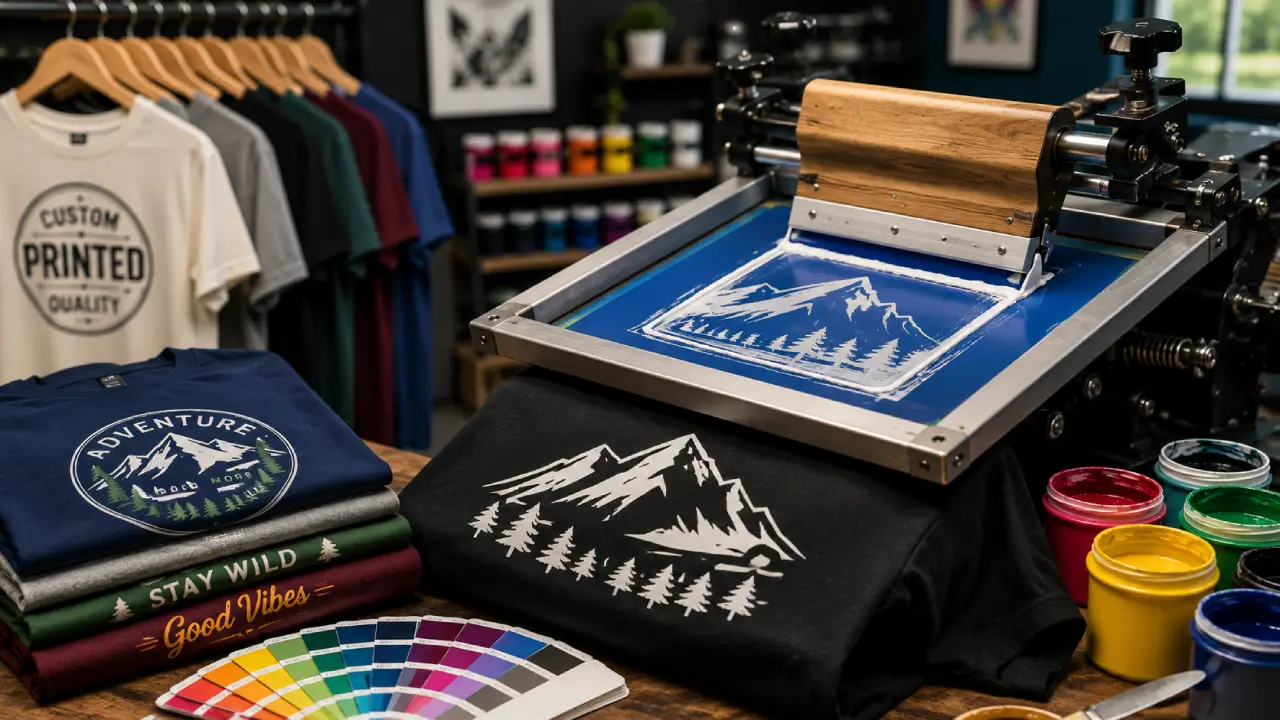

Walk into any concert, sports event, or company picnic and look around. Chances are, most of the custom shirts you see were made using screen printing. It has been the go-to method for decades, and honestly, that is not changing anytime soon. Screen printing for shirts gives you colors that actually pop, a print that survives the washing machine, and a cost per shirt that gets better the more you order. Before you place an order, though, it helps to know what you are paying for and why.
What Is Screen Printing and How It Works
Think of it like a high-powered stencil process. A mesh screen is stretched over a frame, and a design gets burned onto it using a light-sensitive coating. Wherever the design is open, ink passes through onto the shirt. Each color in your artwork needs its own separate screen.
From there, the shirts go through a screen printing press machine. This piece of equipment lines up all your color stations and moves each garment from one to the next. An operator pulls a squeegee across every screen, laying down one color at a time. After printing, the shirts go through a dryer that heats the ink to the point where it fuses with the fabric. That heat cure step is what makes the print last.
Benefits of Screen Printing for Shirts
The Colors Actually Hold Up
Anyone who has bought a cheap printed shirt knows what happens after a few washes. The design cracks, fades, or peels. Screen printing does not do that. The ink gets pressed into the fibers, not just laid on top. You can wash it, wear it constantly, and it still looks good two years later.
Nothing Matches the Color Payoff
If you have tried other printing methods on a dark shirt, you know how washed-out colors can look. Screen printing uses thick, opaque inks that sit rich and bright even on black or navy fabric. Brands that are serious about how their colors look almost always go with screen printing.
Bulk Orders Make Financial Sense
Setting up screens costs money upfront, but once you are running, the cost per shirt drops fast. This is where screen printing for clothes wins hands down. If you are doing 50 shirts or more, you will almost certainly pay less per piece than you would with heat transfer or digital printing. The larger the order, the better the deal.
It Works on More Than Just Tees
Screen printing apparel covers a lot of ground. Hoodies, tanks, long sleeves, performance polos, even tote bags. As long as the surface is printable, the method works. That flexibility is a big reason shops stick with it.
Step-by-Step Screen Printing Process
Artwork Separation: Your design gets broken down by color. Five colors means five screens. This is why keeping your design simple saves money.
Burning the Screens: Each screen gets coated with emulsion, then your design is exposed onto it using UV light. The exposed areas harden. The rest washes away, leaving open mesh where ink will pass through.
Loading the Press: The screens go onto the screen printing press machine, aligned precisely so every color lands exactly where it should. Even a small shift throws the whole design off.
Running the Shirts: One shirt at a time, the operator pulls the squeegee across each screen. The shirt rotates through every color station before coming off the press.
Curing: Shirts pass through a conveyor dryer at high heat. This step is non-negotiable. Undercured ink will crack the first time it hits the wash.
Inspection: Every piece gets looked over before it is bagged or boxed. Anything that does not pass gets pulled.
Types of Screen Printing Techniques
Spot Color is what most people picture. Solid colors, premixed, printed one at a time. Great for logos and anything with clean lines.
Halftone breaks images down into dots of varying sizes to fake shading and gradients. You get the look of multiple tones using fewer actual ink colors.
Discharge Printing strips the dye out of the fabric in the print area and replaces it with a new color. The result feels like nothing is there, just super soft fabric with color baked in. Very popular for retail-quality apparel.
Water-Based Inks absorb into the shirt rather than coating the surface. Softer feel, more breathable, and better for eco-conscious brands.
Cost Breakdown: What Affects Pricing
No two orders cost the same. Here is what moves the needle.
The number of colors is the biggest factor. Every color needs its own screen and setup time. A two-color design will always run cheaper than a six-color one at the same quantity.
Order size matters just as much. Most shops price in tiers around 24, 48, 72, and 100 pieces. Going from 24 to 48 shirts can drop your per-piece cost by a few dollars, which adds up quickly.
The shirt itself is a real cost driver too. A basic wholesale tee is cheap. A soft tri-blend or performance polo might cost three times as much before any ink touches it.
Print locations, specialty inks like metallics or puff ink, and rush timelines all push the price up as well.
A rough ballpark for a one or two color print on a standard tee at 50 pieces runs somewhere between $8 and $18 per shirt. Shop quality and location shift that number either way.
When to Choose Screen Printing Over Other Methods
Screen printing makes sense when your order is 24 pieces or more, your design is bold and uses a limited color palette, and you need prints that hold up to real-world use. It does not make sense for a one-off shirt, a design with photographic detail, or anything that needs individual customization like different names on each piece. For those situations, direct-to-garment printing is worth exploring instead.
Common Mistakes to Avoid
Sending low-quality artwork is probably the most common mistake people make. If your logo came from a website, it is likely 72 DPI and will print like a blurry mess. Always send vector files or at minimum a 300 DPI image.
Skipping the proof is another one. No matter how simple the design, always approve a mockup before the press starts running. Fixing a mistake after the fact is expensive and sometimes impossible.
Trying to squeeze in too many colors to save on a low quantity order almost never works out in your favor. Fewer colors, bigger order. That is the formula for getting the best price.
Design Tips for Better Print Results
Bold and simple always prints better than detailed and complicated. Tiny text below a quarter inch and ultra-fine details tend to fill in or bleed during printing. If it looks delicate on screen, it will likely be a problem on fabric.
Stick to three or four colors when you can. It keeps costs down and the best-looking shirts are rarely the busiest ones.
Printing on dark fabric? Ask about a white underbase. That is a layer of white ink printed first so the colors on top actually read correctly. Costs a touch more but the payoff is obvious.
Looking for Professional Printing Services?
Finding a shop that does both screen printing and embroidery in one place makes life a lot easier. You deal with one team, one timeline, and one contact for everything from printed tees to embroidered hats.
If you are based in South Florida, the options for screen printing West Palm Beach have gotten really solid. PalmBeachShirts.com is worth a look if you want a local shop that handles both small runs and large wholesale orders. Being able to stop in, see the equipment, and talk through your project in person takes a lot of the guesswork out of the process.
Frequently Asked Questions
How many shirts do I need to make screen printing worth it?
Most shops say 24 to 48 is the starting point where pricing starts making sense compared to other methods.
How many washes will a screen print survive?
A properly cured print on quality fabric should hold up through 50 or more washes with no significant fading when washed inside out in cold water.
Can you screen print on dark shirts?
Absolutely. A white underbase gets printed first, then the colors go over it. That is what keeps them bright and true on dark fabric.
What file type should I send my printer?
Vector files are the best option. AI, EPS, or PDF. If you only have a raster file, make sure it is at least 300 DPI.
How long does an order take?
Most shops turn orders around in 7 to 14 business days once artwork is approved. Rush turnaround is available at some places for an added fee.
Will it work on polyester?
Yes, though polyester needs specific inks to avoid dye migration. Always let your printer know the fabric content upfront.
What makes water-based printing different?
The ink soaks into the fabric instead of sitting on top of it. The feel is much softer, almost like the design is part of the shirt rather than printed on it.
How is screen printing different from embroidery?
Screen printing is flat and uses ink. Embroidery is raised and uses thread. Both look sharp, just in different ways depending on the garment and the look you are going for.
Conclusion
Custom shirts are one of the most effective ways to put your brand, message, or design in front of people, and the method you choose matters. Screen printing for shirts continues to be the most dependable option for anyone ordering in volume and wanting a finished product that actually holds up. Get your artwork right, keep the design clean, and find a printer who knows what they are doing. Everything else falls into place from there.